

Online shopping is entering a new phase. Customers are no longer limited to typing product names into search engines, comparing individual websites, and manually filtering endless product listings. AI-powered shopping assistants are increasingly helping consumers research products, compare options, and make purchasing decisions.
For ecommerce businesses, this creates an important question: Is your online store structured well enough for AI shopping agents to understand what you sell?
Preparing for AI shopping agents in ecommerce is not simply about adding a chatbot to your website. It involves product data quality, accurate inventory, website performance, checkout reliability, and the ability to communicate product information clearly.
As AI-assisted shopping develops, retailers need to evaluate whether their existing ecommerce infrastructure can support new customer discovery experiences without compromising usability or security.
What Are AI Shopping Agents?
AI shopping agents are software assistants designed to help consumers discover, research, compare, and potentially purchase products using natural-language instructions.
Instead of searching for a specific product name, a customer might ask:
“Find a waterproof laptop backpack under $100 that fits a 16-inch laptop and can arrive before Friday.”
An AI shopping assistant may evaluate product specifications, pricing, availability, delivery information, and other relevant details before suggesting suitable products.
Some AI systems focus on product research and recommendations, while others support more advanced purchasing experiences through eligible retailer integrations.
However, being recommended by an AI shopping assistant does not automatically mean a product can be purchased directly through that system.
For businesses investing in ecommerce development services, understanding this distinction is important when planning future website improvements.
Why Traditional Ecommerce Websites May Struggle
Many ecommerce websites are primarily designed around visual browsing.
Although their product pages may look attractive, important information is sometimes difficult for search engines, comparison tools, and emerging AI systems to interpret.
For example, an online furniture store might display beautiful product photographs without clearly identifying dimensions, materials, delivery restrictions, or assembly requirements.
Common problems include:
- Product specifications hidden inside images.
- Inconsistent product names across categories.
- Outdated pricing and stock information.
- Missing product attributes.
- Unclear shipping and return policies.
- Duplicate or incomplete product descriptions.
- Poorly configured product variations.
These weaknesses can create confusion for customers and automated shopping systems.
The solution begins with improving the quality and consistency of product information.
1. Build Product Pages Around Clear Attributes
AI-assisted shopping depends on identifying products that match specific customer requirements.
A product page should clearly communicate essential details without forcing visitors to search through multiple sections.
Consider an ecommerce store selling office chairs.
A basic product description might say:
“Premium ergonomic office chair for modern workspaces.”
Although this sounds appealing, it provides little practical information.
A stronger product description would include seat dimensions, adjustable features, supported weight capacity, materials, available colors, warranty details, and assembly requirements.
These attributes help customers make informed decisions and make product information easier for automated systems to interpret.
Where possible, businesses should store important specifications in organized product fields rather than relying entirely on free-form descriptions.
This approach also simplifies product filtering, catalog management, and future integrations.

2. Maintain Accurate Pricing and Inventory
AI shopping assistants become less useful when they recommend products that are unavailable or display outdated prices.
Retailers should regularly verify that inventory information remains consistent across their websites and connected sales channels.
Important information includes:
- Product availability by variation.
- Current selling price and currency.
- Sale pricing and expiration dates.
- Shipping eligibility.
- Backorder availability.
- Discontinued product status.
Retailers should also confirm that product feeds and integrations accurately reflect their store’s current information.
For businesses using Shopify development services, properly configured inventory synchronization, product variants, and sales-channel integrations can help maintain consistency.
Reliable information is more valuable than maintaining a large but inaccurate product catalog.
3. Improve Structured Product Information
Structured data helps supported search engines understand product information.
For ecommerce websites, relevant product markup can communicate information such as product names, prices, availability, and supported product attributes.
However, structured data must accurately represent the information visible on the website.
Adding product schema does not guarantee inclusion in AI-generated shopping recommendations or enhanced search features.
Store owners should also ensure that important product pages are accessible to search engines and that canonical URLs, indexing settings, and website architecture are correctly configured.
Professional SEO services can help businesses identify technical issues affecting product visibility and search accessibility.
These traditional SEO foundations remain valuable as AI-powered shopping experiences evolve.
4. Make Product Variations Understandable
Product variations can create technical problems when they are not configured consistently.
For example, a clothing store may offer the same jacket in five sizes and four colors.
Different variations may have different prices, stock availability, product identifiers, or photographs.
Poor variation management can create mismatches between what customers select and what the system records.
Stores using WooCommerce development services should review product attributes, variable products, inventory settings, and catalog configuration.
The objective is to maintain accurate product information across every available variation.
5. Prepare a Reliable Checkout Experience
Better product discovery matters only when customers can complete purchases successfully.
Checkout problems can interrupt the buying journey even when product recommendations are accurate.
Retailers should evaluate:
- Mobile checkout usability.
- Payment gateway reliability.
- Shipping calculations.
- Tax configuration.
- Coupon compatibility.
- Guest checkout availability.
- Order confirmation functionality.
Security and customer authorization are also essential.
AI-assisted purchasing experiences should never bypass payment consent, fraud-prevention safeguards, or customer privacy requirements.
Although agent-assisted commerce may introduce additional integrations, conventional checkout reliability remains a priority for most retailers.
6. Improve Website Speed and Mobile Performance
Slow ecommerce websites create unnecessary friction for customers.
Large images, excessive scripts, unnecessary plugins, and inefficient hosting configurations can affect loading speed.
Businesses should evaluate product pages, category pages, shopping carts, and checkout experiences rather than focusing exclusively on homepage performance.
Core Web Vitals provide useful performance signals, but website testing should also include real customer journeys.
A fast homepage offers little benefit if product selections, cart updates, or checkout interactions remain slow.
7. Create Product Information That Answers Real Questions
Product descriptions should explain more than basic features.
Customers often need to understand compatibility, installation requirements, product limitations, materials, maintenance, and suitable use cases.
For example, a commercial lighting supplier may need to explain electrical compatibility, installation conditions, dimensions, and maintenance requirements.
Providing this information supports informed purchasing decisions and reduces unnecessary customer support inquiries.
Helpful content can include buying guides, product comparisons, technical FAQs, and accurate compatibility information.
Businesses should avoid generating hundreds of nearly identical product descriptions solely to target additional keywords.
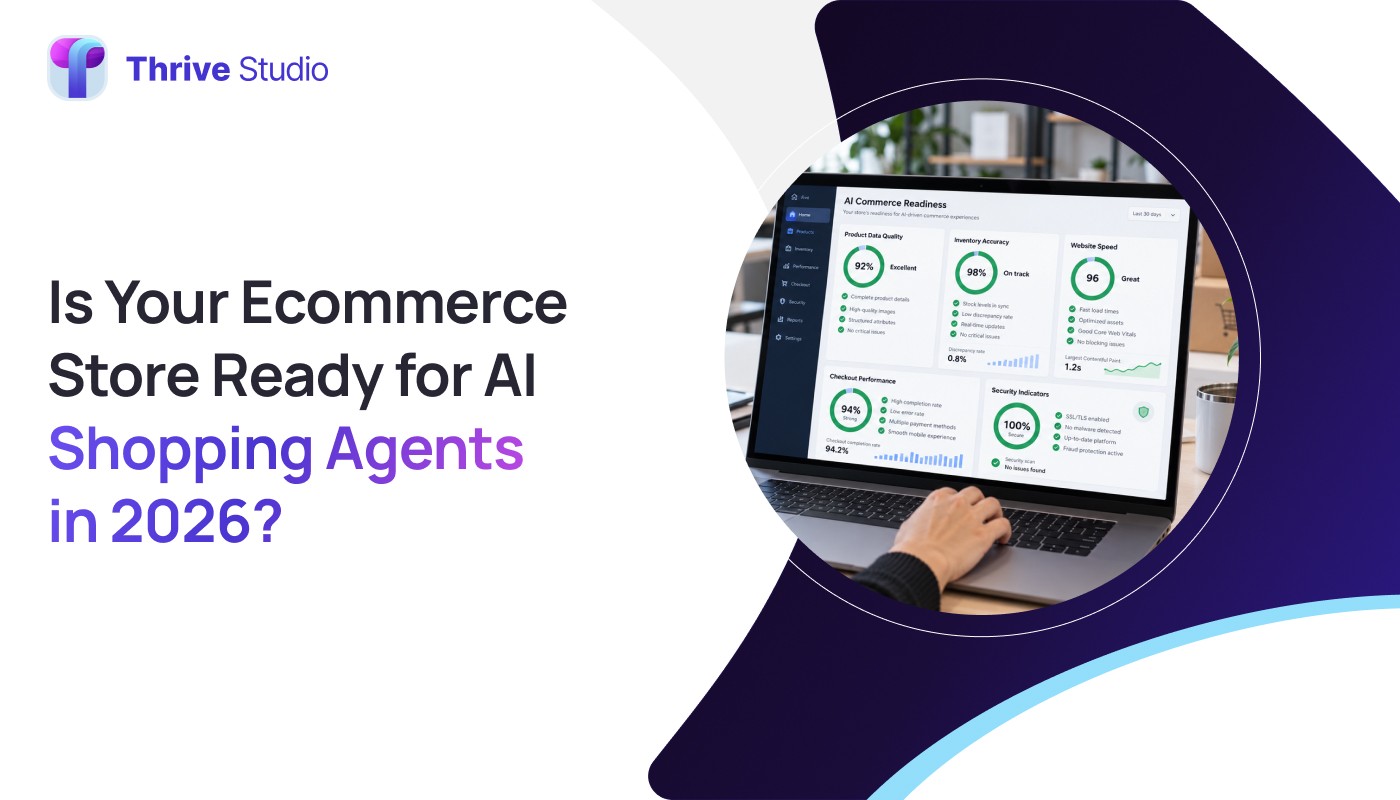
8. Develop an AI Commerce Readiness Scorecard
Before investing in expensive new technology, ecommerce businesses can evaluate their current stores using five practical categories.
| Readiness Area | What to Evaluate |
| Product Data | Are product specifications accurate and complete? |
| Technical Accessibility | Can supported systems access important product information? |
| Inventory Reliability | Are prices, stock levels, and variations updated correctly? |
| Customer Experience | Can customers browse and complete checkout easily? |
| Operational Controls | Are payments, permissions, and customer data protected? |
Businesses can score each category from 0 to 2.
0 — Needs Improvement: Significant problems require attention.
1 — Partially Ready: Basic functionality exists but needs optimization.
2 — Strong Foundation: Information and processes are documented, tested, and reliable.
The maximum score is 10.
This is an internal assessment framework, not an official AI-commerce certification or a guarantee of compatibility with any shopping platform.
Businesses with lower scores should prioritize improving their existing ecommerce infrastructure before introducing additional integrations.

Should Every Ecommerce Business Invest in AI Shopping Agents Right Now?
Not necessarily.
Smaller ecommerce businesses with incomplete product information, unreliable inventory, or checkout issues may benefit more from addressing these problems first.
Larger retailers with mature product catalogs, reliable integrations, and established technical infrastructure may be better positioned to evaluate emerging agent-assisted commerce capabilities.
The appropriate strategy depends on business size, customer expectations, product complexity, and available resources.
AI shopping technologies and platform capabilities continue to evolve, making ongoing evaluation important.
Prepare Your Ecommerce Store for the Next Shopping Shift
AI-powered shopping is changing how consumers discover and compare products, but successful ecommerce experiences still depend on practical fundamentals.
Clear product information, accurate inventory, reliable checkout processes, and accessible website architecture help businesses support customers today while preparing for emerging technologies.
At Thrive Studio Inc., we focus on building scalable ecommerce solutions around real business needs.
Whether your business uses Shopify, WooCommerce, or a custom ecommerce platform, improving your existing store infrastructure is an important step toward future readiness.
Ready to improve your ecommerce website?
Explore how Thrive Studio Inc. can help evaluate your store’s performance, product structure, and development requirements.
Frequently Asked Questions
What are AI shopping agents in ecommerce?
AI shopping agents are software assistants that help customers research, compare, and potentially purchase products through natural-language interactions.
Can AI shopping agents purchase products from every ecommerce website?
No. Purchasing capabilities depend on supported platforms, retailer integrations, checkout functionality, and customer authorization.
How can Shopify stores prepare for AI shopping?
Shopify stores can improve product descriptions, variations, inventory synchronization, structured information, and checkout reliability. Specific agentic-commerce capabilities depend on supported channels and eligibility.
How can WooCommerce websites prepare for AI-powered shopping?
WooCommerce websites can improve product attributes, stock accuracy, technical SEO, website performance, and checkout functionality.
Will AI shopping agents replace traditional ecommerce websites?
Not necessarily. Businesses should prepare for AI-assisted discovery while continuing to support customers who browse and purchase directly through their websites.