
Your website may be indexed by Google, have optimized service pages, and receive organic traffic, yet still struggle to appear in AI-generated search experiences.
With Google AI Overviews and AI Mode changing how people discover information, businesses are asking an important question: Why do some websites appear in AI-powered answers while others remain difficult to discover?
The answer is rarely a missing keyword or a special optimization trick.
In most cases, AI search visibility begins with the same foundations that support traditional search engine optimization: accessible pages, helpful content, clear business information, technical performance, and trustworthy information.
For businesses investing in professional SEO services, understanding these foundations is essential when developing a sustainable search strategy.
This guide explains how to audit your website in 2026 and identify issues that may limit its visibility in Google Search and AI-powered discovery experiences.
What Is AI Search Visibility?
AI search visibility refers to how a website or its information appears in AI-powered search experiences.
These experiences may generate answers, summarize information, compare solutions, and reference relevant websites.
For example, a business owner searching for website development solutions might ask:
“What should a growing ecommerce business consider before replacing its existing website?”
An AI-powered search experience may provide an explanation covering technical requirements, development platforms, migration considerations, and website performance.
Relevant websites may be referenced as supporting sources.
However, appearing in traditional Google results does not guarantee inclusion in AI-generated answers.
Likewise, a website does not need special AI-only markup to become eligible for Google’s AI search features.
Google’s published guidance explains that existing SEO best practices remain relevant for AI Overviews and AI Mode.
1. Check Whether Search Engines Can Access Your Website
Before optimizing content for AI search, confirm that search engines can access your important pages.
Technical restrictions can prevent valuable content from being discovered.
Common problems include:
- Incorrect robots.txt directives.
- Accidental noindex tags.
- Broken XML sitemaps.
- Incorrect canonical URLs.
- Redirect loops.
- Server errors.
- Important pages excluded from indexing.
For example, a business may have detailed pages for website development, ecommerce solutions, and digital marketing.
If those pages are accidentally excluded from Google’s index, their ability to appear in Google Search is limited.
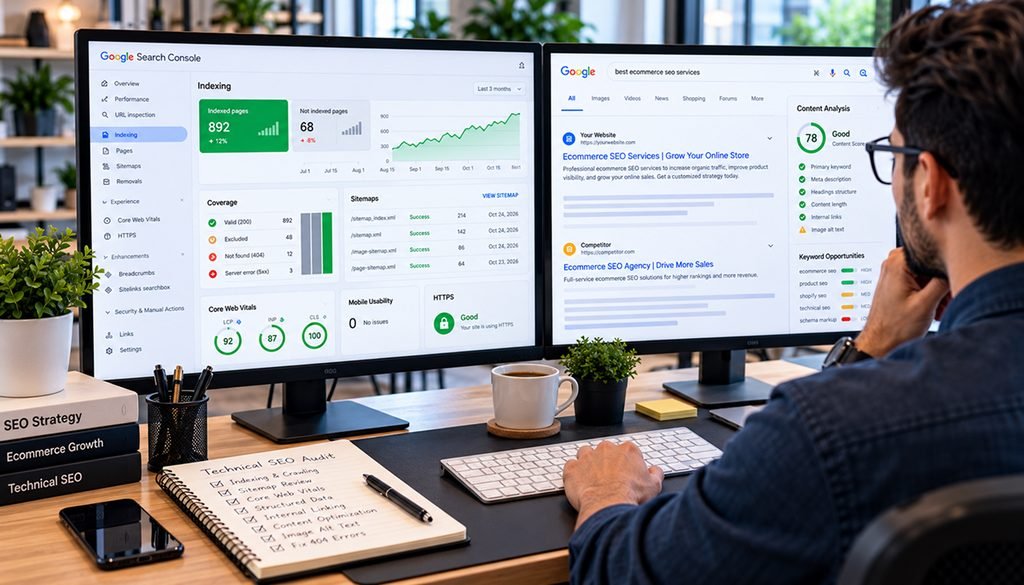
Start by opening Google Search Console and checking the indexing status of your important URLs.
Use the URL Inspection tool to investigate individual pages.
Remember that submitting a sitemap or requesting indexing does not guarantee that Google will index a page.
2. Identify Pages That Do Not Clearly Explain Their Purpose
Many business websites rely on generic marketing statements.
For example:
“We provide innovative digital solutions that empower modern businesses.”
Although this sounds professional, it does not explain what the company actually does.
A stronger service page should clearly describe the service, its intended customers, and the problems it solves.
A web development business might explain whether it provides WordPress websites, ecommerce platforms, custom applications, or integrations.
It should also describe the development process, available support, and relevant technical capabilities.
Businesses providing web application development services should clearly explain supported application types, user requirements, and development considerations.
When content is easy for visitors to understand, it also provides clearer context for search systems.
3. Improve Content Quality Beyond Keyword Placement
Keywords still help establish a page’s relevance, but repeating the same phrase throughout a page does not automatically make it authoritative.
Search-focused content should answer questions that matter to its intended audience.
For service pages, these might include:
- What does the service involve?
- Who needs the service?
- What problems does it solve?
- What technologies are supported?
- What affects the project timeline?
- What happens after launch?
A useful page answers these questions naturally.
It also avoids repeated paragraphs, unsupported promises, and content created solely to attract search traffic.
Businesses should review existing content before publishing additional pages.
Improving a weak but relevant service page may be more useful than publishing multiple articles that repeat the same information.
4. Demonstrate Experience Through Original Information
One of the most common weaknesses in business blogs is generic content.
Many articles discuss the same industry trends without adding practical examples or meaningful analysis.
Original information can make an article more useful.
Consider publishing:
- Real development challenges and how they were addressed.
- Website migration lessons.
- Verified performance improvements.
- Practical comparisons between technology platforms.
- Project planning checklists.
- Explanations of common implementation mistakes.
For example, a digital agency might explain why a custom content management system was selected for a particular project.
Another article could compare the operational requirements of Shopify, WooCommerce, and custom ecommerce platforms.
These examples help readers understand real business decisions.
Avoid inventing client results or presenting hypothetical projects as completed case studies.
5. Strengthen Website Structure and Content Organization
A website should help visitors move between related topics without unnecessary confusion.
For example, a digital agency might organize its website around primary service categories such as web development, ecommerce, mobile applications, and SEO.
Each category can contain specialized service pages.
Clear navigation and relevant internal links help visitors discover related information.
They can also help search engines understand the relationship between different pages.
Businesses using custom CMS development services should consider how their website’s content architecture supports navigation, accessibility, and future expansion.
However, internal links should be added because they help users, not simply to increase keyword usage.
6. Make Business Information Consistent and Trustworthy
Search visibility is not only about technical configuration.
Visitors need accurate information before they can trust a business.
Review whether your website clearly communicates:
- Official business name.
- Contact information.
- Services offered.
- Company background.
- Authentic portfolio examples.
- Accurate team information, when appropriate.
- Verified customer testimonials.
If a business claims to have a physical office, that location should represent an actual business location.
Similarly, websites should not display fictional testimonials or unverified performance claims as factual results.
Consistent and trustworthy information supports better customer decisions and a stronger business presence.
7. Improve Website Performance and Accessibility
Website speed and usability remain important elements of a professional digital experience.
Slow-loading pages, broken navigation, inaccessible forms, and poor mobile layouts can prevent visitors from interacting with a website.
A technical review should include:
Loading performance: How quickly does the main content appear?
Interaction responsiveness: Do menus, forms, and buttons respond reliably?
Visual stability: Do elements move unexpectedly while loading?
Mobile usability: Can visitors complete important actions on smaller screens?
Accessibility: Are headings, buttons, labels, and navigation understandable?
Google’s Core Web Vitals provide useful performance measurements.
However, businesses should also test real customer journeys rather than focusing exclusively on numerical performance scores.
8. Use Structured Data Correctly
Structured data provides additional information about supported webpage content.
Depending on the page, relevant markup may describe an organization, article, product, or other supported entity.
However, structured data should accurately reflect the information visible to website visitors.
Adding schema markup does not guarantee inclusion in AI Overviews or AI Mode.
Google also states that no special AI-specific structured data is required for these search experiences.
Businesses should focus on valid markup, accessible content, accurate information, and technical consistency rather than unsupported optimization shortcuts.
Latest Reading: Is Your Ecommerce Store Ready for AI Shopping Agents in 2026?
AI-powered discovery is not limited to informational searches. Ecommerce businesses are also preparing for shopping assistants that help customers research products and compare purchasing options.
Our latest article, Is Your Ecommerce Store Ready for AI Shopping Agents in 2026?, explains how product data accuracy, inventory management, structured information, checkout reliability, and website performance affect ecommerce readiness.
It includes a practical scorecard that online retailers can use to identify improvement opportunities before investing in emerging AI shopping technologies.
9. Develop an AI Search Visibility Audit Scorecard
Instead of guessing which optimization tasks matter most, businesses can evaluate their websites using a simple internal framework.
| Audit Area | What to Review |
| Crawlability | Can search engines access important pages? |
| Indexability | Are priority pages eligible for indexing? |
| Content Clarity | Does each page clearly explain its topic? |
| Original Value | Does the content provide useful information? |
| Business Trust | Are company details and claims accurate? |
| User Experience | Is the website responsive and accessible? |
| Measurement | Are analytics and Search Console configured? |
Assign a score from 0 to 2 for each category.
0 — Needs Improvement: Significant problems remain unresolved.
1 — Partially Optimized: Basic requirements are met, but improvements are needed.
2 — Strong Foundation: Important requirements are implemented, tested, and regularly reviewed.
The maximum score is 14.
This scorecard is an internal prioritization tool, not an official Google ranking factor or certification.
Use the results to identify which technical and content improvements deserve attention first.
10. Measure AI Search Visibility Without Expecting Immediate Results
SEO improvements require monitoring and evaluation.
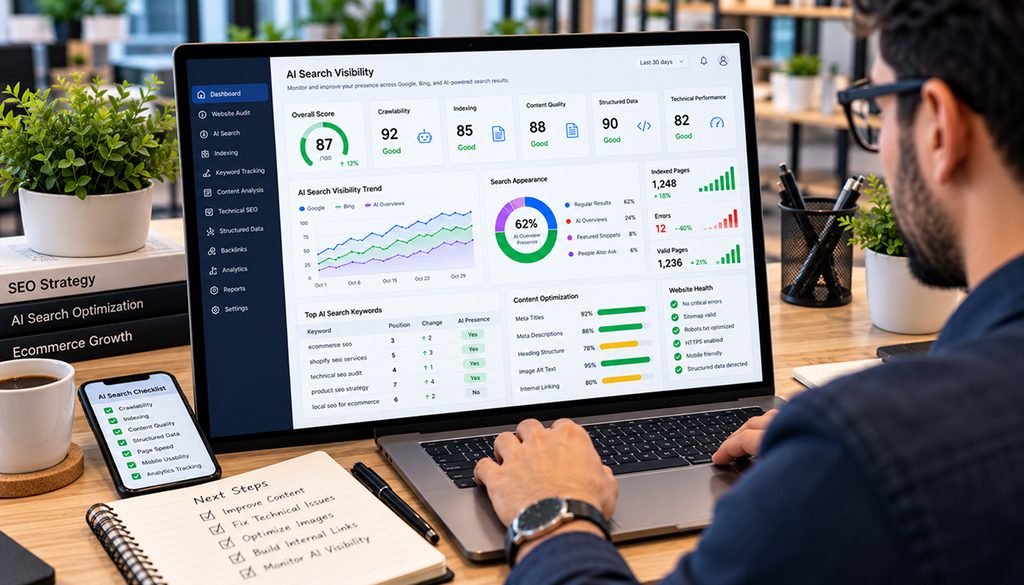
Google Search Console can help identify indexing issues, search impressions, clicks, and queries.
Businesses should also track meaningful outcomes, such as qualified inquiries, consultation requests, and organic conversions.
Avoid treating a single AI-generated answer as a definitive measure of search performance.
AI-powered search results can vary depending on the query, search context, and available information.
A stronger measurement strategy looks at performance trends over time rather than isolated examples.
Common AI Search Optimization Mistakes
Businesses should avoid several common mistakes when improving their websites.
Publishing repetitive AI-generated content: Large volumes of generic articles may add little useful information.
Ignoring technical SEO: Valuable content can struggle when important pages are inaccessible or improperly configured.
Overusing keywords: Repeating exact phrases does not automatically improve authority.
Depending on unsupported AI SEO tricks: Special files or unverified markup techniques do not guarantee inclusion in AI-powered search.
Ignoring user experience: A website still needs to serve real visitors effectively.
The strongest approach combines technical optimization with accurate, useful, and original information.
What Should Businesses Prioritize First?
Businesses with limited SEO resources should begin with foundational improvements.
First, confirm that important pages are accessible and eligible for indexing.
Second, make service descriptions clear and specific.
Third, improve existing content with useful information that addresses real customer needs.
Fourth, review website performance, accessibility, and business credibility.
Finally, use analytics to evaluate progress and identify future improvements.
These actions support traditional search performance while preparing websites for evolving AI-powered discovery experiences.
Build a Website That Deserves to Be Discovered
AI-powered search is changing how people discover information, but useful websites remain central to that experience.
Businesses that publish trustworthy content, maintain accessible website architecture, and explain their services clearly establish a stronger foundation for long-term organic visibility.
At Thrive Studio Inc., we focus on connecting website development, technical optimization, and digital growth strategies with practical business requirements.
Whether your website needs better indexing, improved content, stronger technical SEO, or a more effective digital strategy, progress begins with understanding what is already working and what needs improvement.
Ready to improve your website’s visibility?
Explore how Thrive Studio Inc. can help identify technical SEO issues, content opportunities, and practical improvements to support long-term organic growth.
Frequently Asked Questions
What is AI search visibility?
AI search visibility describes how a website or its information appears in AI-powered search experiences, including systems that generate answers and reference relevant online sources.
Can my website appear in Google AI Overviews without special tools?
Yes. Google’s guidance states that established SEO best practices remain relevant, and there are no additional technical requirements specifically for AI Overviews or AI Mode beyond normal Search eligibility.
Does adding schema markup guarantee AI search visibility?
No. Structured data can help supported search systems interpret information, but it does not guarantee inclusion in AI-generated answers.
How long does AI search optimization take?
There is no guaranteed timeline. Results depend on indexing, competition, content relevance, technical quality, and changes in search systems.
Should businesses replace traditional SEO with AI search optimization?
No. Technical SEO, useful content, clear website structure, and accurate business information remain important for both traditional and AI-enhanced Google Search.