

Introduction: Shopify’s New Era of AI Commerce
Online shopping is changing as artificial intelligence becomes part of product discovery, recommendations, and checkout experiences.
Shopify’s Fall 2026 update introduces new tools designed to connect merchants with AI-powered shopping experiences. Features such as Shop.md, Shop.dev, WebMCP, and Universal Checkout demonstrate how ecommerce platforms are preparing for customers who use AI assistants to shop.
For businesses, these developments create opportunities to improve product visibility, simplify purchasing, and reach customers through emerging sales channels.
However, adopting AI commerce requires accurate product information, reliable checkout systems, and a well-maintained storefront.
This guide explains the most important Shopify AI shopping agents 2026 developments and how online retailers can prepare.
1. What’s New in Shopify’s Fall 2026 Update?
Shopify’s Fall ’26 Edition introduces improvements across AI commerce, checkout technology, and storefront development.
A major focus is agentic commerce, where AI assistants help customers perform shopping tasks.
Instead of visiting multiple stores, shoppers may use compatible AI assistants to discover products, compare options, manage carts, and complete purchases with authorization.
For merchants, this introduces another potential discovery channel alongside Google, social media, marketplaces, and traditional ecommerce websites.
Businesses investing in Shopify development services should evaluate how these capabilities fit their long-term ecommerce strategy.
2. Shop.md and Shop.dev: AI-Powered Product Discovery
Shop.md and Shop.dev are two important additions to Shopify’s AI commerce ecosystem.
Shop.md helps compatible AI assistants discover products and provide shopping recommendations.
Shop.dev offers developers access to Shopify commerce functionality, including product information, carts, and checkout capabilities.
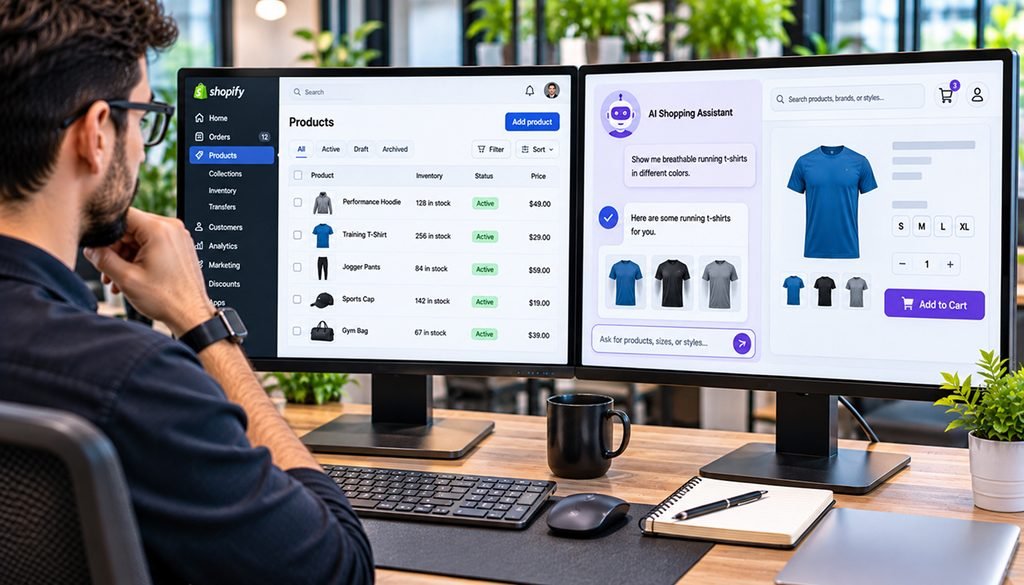
For example, a customer searching for affordable running shoes could ask an AI assistant to identify products matching a specific budget, size, and style.
The assistant may use supported commerce tools to find relevant products without requiring the shopper to browse numerous websites.
For merchants, accurate product information becomes increasingly important.
Product titles, descriptions, prices, availability, and variants should clearly communicate what each item offers.
AI shopping tools cannot compensate for incomplete or misleading product listings.
3. WebMCP: Connecting AI Agents With Shopify Stores
WebMCP introduces structured interactions between compatible browser-based AI agents and Shopify storefronts.
Instead of relying entirely on visual navigation, supported agents can interact with shopping functions through defined tools.
These may include searching products, updating shopping carts, reviewing checkout details, and completing authorized purchases.
This approach could make automated shopping experiences more consistent.
However, compatibility depends on the AI agent, storefront configuration, and supported platform features.
Merchants using custom themes or third-party applications should test important shopping workflows carefully.
A professionally developed ecommerce website should remain easy to use for customers while supporting new technologies.
4. Universal Checkout: A More Connected Shopping Experience
Traditional ecommerce checkout usually takes place within a single online store.
Shopify’s Universal Checkout introduces support for purchasing products from multiple participating merchants through a unified shopping experience.
For example, a customer might select accessories from one retailer and clothing from another.
Supported shopping environments could bring these products together into one checkout process.
This may reduce friction for customers who regularly shop across different brands.
For merchants, Universal Checkout creates potential opportunities to reach customers beyond their own storefronts.
However, shipping requirements, payment processing, fulfillment, and return policies still need careful consideration.
Businesses should evaluate actual availability and compatibility before planning changes around this feature.
5. Shop Pay and Secure AI-Assisted Payments
Payment security remains essential as AI shopping develops.
Customers may trust AI assistants to recommend products but expect stronger safeguards when financial transactions are involved.
Shopify is expanding Shop Pay capabilities into supported AI shopping experiences, emphasizing buyer authorization and protected payment credentials.
For merchants, reliable payment processing is critical.
Stores should regularly test checkout functionality, payment gateways, order confirmations, and shipping calculations.
Security reviews should also cover administrator permissions, third-party integrations, and customer information.
AI-assisted purchasing should improve convenience without weakening customer trust.
6. New Shopify Theme Architecture
Shopify’s Fall 2026 update also introduces improvements for developers working with storefront themes.
The updated architecture emphasizes flexible templates, reusable components, and modern development workflows.
These changes may help developers manage custom storefront experiences more efficiently.
For businesses, improved development tools can support maintainability, performance, and future customization.
However, existing Shopify stores do not necessarily require an immediate redesign.
Merchants should evaluate whether upgrading their theme would deliver measurable improvements in usability, speed, accessibility, or conversions.
A successful ecommerce redesign should solve business problems rather than simply introduce new technology.
7. Why Product Data and Ecommerce SEO Matter
AI-powered shopping relies on structured, accurate product information.
If a product listing lacks important details, automated systems may struggle to evaluate its relevance.
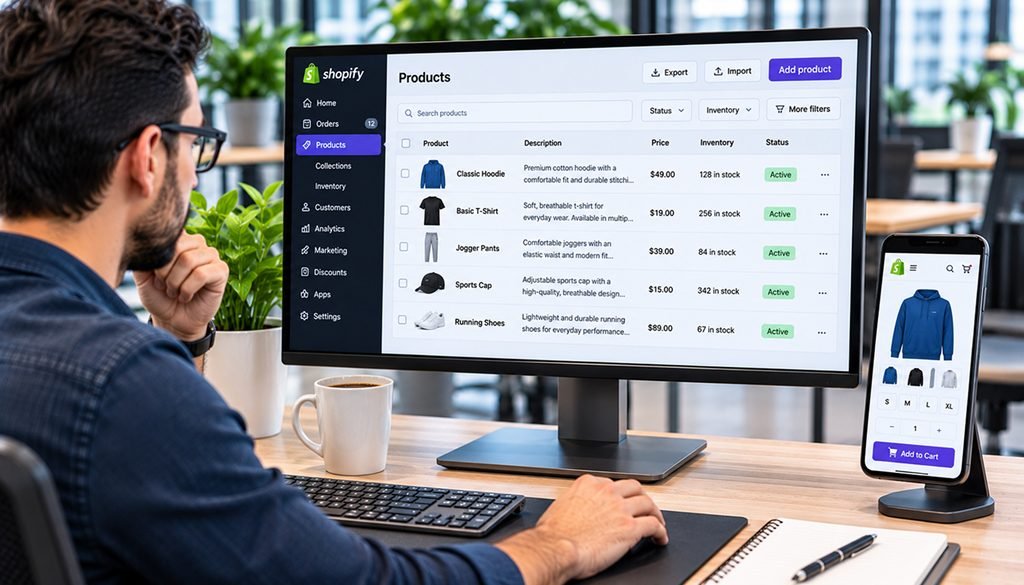
Merchants should optimize product titles, descriptions, images, variants, pricing, and availability.
Shipping details, return policies, and product identifiers also contribute to clearer shopping experiences.
For example, an apparel retailer should provide accurate sizes, materials, colors, and stock information rather than using generic descriptions.
These improvements benefit both traditional shoppers and compatible AI assistants.
Professional SEO services can help retailers improve product-page organization, technical accessibility, and search visibility.
8. Shopify AI Shopping Readiness Checklist
Before investing in new AI integrations, businesses should review their existing ecommerce infrastructure.
| Area | Recommended Action |
| Product catalog | Improve descriptions and variants |
| Inventory | Maintain accurate stock levels |
| Product images | Use high-quality visuals |
| Checkout | Test payment and shipping |
| Website performance | Optimize mobile experience |
| Theme compatibility | Review customizations |
| Security | Protect customer information |
| Analytics | Monitor conversion performance |
| AI compatibility | Test supported shopping tools |
A store does not need every emerging AI feature to remain competitive.
For many merchants, improving product data, mobile performance, and checkout reliability will provide more immediate benefits.
Latest Reading: WordPress Security Alert 2026
WordPress Security Alert 2026: Is Your Business Website at Risk?
As ecommerce platforms become more connected, website security remains a major business priority.
Our recent guide explains WordPress security vulnerabilities, outdated plugins, hosting risks, and practical protection measures for business websites.
9. How Shopify Merchants Should Prepare
Businesses should approach AI commerce with a practical implementation strategy.
Start by reviewing product information and correcting missing or inconsistent details.
Next, test the complete shopping experience, including product selection, cart functionality, checkout, and order confirmation.
Review your Shopify theme and installed applications for compatibility and performance issues.
Merchants exploring AI shopping integrations should confirm which capabilities are supported before investing in custom development.
Finally, measure results using conversion rates, checkout completion, order accuracy, and customer engagement.
These metrics help businesses determine whether new technology is creating meaningful improvements.
10. What the Future of Shopify AI Commerce Means
Shopify’s Fall 2026 developments indicate that ecommerce is expanding beyond traditional website browsing.
Customers may increasingly interact with products through AI assistants, connected applications, and new checkout environments.
However, traditional ecommerce websites will remain important for branding, customer relationships, product information, and direct sales.
Merchants should focus on building flexible storefronts that can support both conventional shopping and emerging technologies.
Accurate information, secure transactions, strong performance, and dependable customer experiences will remain essential.
Frequently Asked Questions
What is Shopify’s Fall 2026 update?
It is a collection of Shopify platform improvements covering AI shopping, checkout capabilities, development tools, and merchant operations.
What are Shopify AI shopping agents?
They are compatible AI assistants that can help customers discover products, compare options, manage carts, and complete authorized purchases.
What is Shopify WebMCP?
WebMCP provides structured tools that allow compatible browser-based AI agents to interact with supported Shopify shopping functions.
Can AI agents complete Shopify checkout?
Supported AI agents can assist with checkout and complete authorized purchases through compatible integrations.
Do Shopify stores need a redesign for AI shopping?
Not necessarily. Merchants should first evaluate product information, theme compatibility, checkout functionality, and performance.
Will AI shopping replace traditional ecommerce SEO?
No. Traditional SEO remains valuable for search visibility and customer acquisition, while AI shopping creates additional discovery opportunities.
Prepare Your Shopify Store for AI Commerce
Shopify’s Fall 2026 update introduces new opportunities for merchants to connect with customers through AI-powered shopping experiences.
However, successful implementation depends on more than adopting new features.
Businesses need accurate product information, secure checkout systems, responsive storefronts, and reliable technical infrastructure.
At Thrive Studio Inc., we help businesses develop and optimize ecommerce websites for performance, usability, and long-term growth.
Whether you’re improving an existing Shopify store or planning new ecommerce functionality, our team can help you prepare for the next generation of online shopping.